
THE Center for Cosmetic Surgery
Neck Lift Surgery
Medically Reviewed by Steven B. Hopping, MD, FACS at The Center for Cosmetic Surgery October 2026
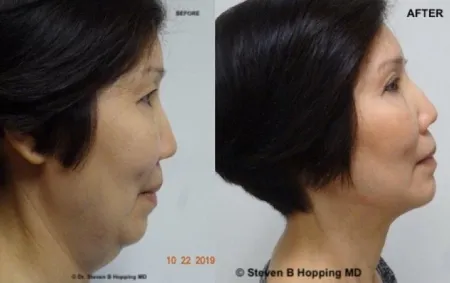
View more before-and-after photos during your office consultation.
Neck Lift Surgery
A neck lift in Washington, DC, is surgery that tightens loose neck skin, treats vertical muscle bands, and can reduce fullness under the chin. The medical names are platysmaplasty and cervicoplasty. Dr. Steven B. Hopping performs the operation himself at The Center for Cosmetic Surgery, 2311 M Street NW. You should see a cleaner jawline and a smoother neck from the side and the front — not a pulled face.
Most patients go home the same day from the practice’s AAAHC-certified facility. A neck lift does not lift fallen cheeks. That is a facelift. Liposuction alone is not a neck lift. Liposuction removes fat. A neck lift also handles skin and muscle. Fallen cheeks need a facelift, not a neck-only plan.
What is a Neck Lift in DC?
A neck lift treats the area from the jaw down. It can fix a turkey-neck drape, vertical platysma bands, a jaw–neck angle that has gone soft, and fullness under the chin. Liposuction may be added when fat is part of that fullness. Liposuction by itself is not a neck lift. It removes fat. A neck lift also handles skin and muscle.
The platysma is the thin muscle that makes those vertical cords when you talk or look down. Platysmaplasty tightens that muscle. Cervicoplasty redrapes extra skin. Both are often done in the same operation so the neck is clean in profile and from the front.
Dr. Hopping plans the neck with the lower face. The neck and jowls usually age together. A neck lift can stand alone when the cheeks still hold, or ride with a mini or full facelift when they do not. If the midface is empty as well as dropped, see Facelift With Fat Transfer. Incisions hide under the chin and, when needed, near the ears — not across the front of the neck.
Who Performs Your Neck Lift Surgery in Washington, DC?
Steven B. Hopping, MD, FACS performs neck lift surgery himself at The Center for Cosmetic Surgery, 2311 M Street NW, Suite 503, Washington, DC 20037. The operation is not delegated to a nurse, a device tech, or a visiting surgeon. Patients come from the District, Maryland, Virginia, and the rest of the DMV.
The boards matter in the neck. He is board-certified in facial plastic and reconstructive surgery, cosmetic surgery, and otolaryngology–head and neck surgery (ENT). That last credential is the anatomy of the throat, ear, and neck — the same structures a platysmaplasty works on. He is a Fellow of the American College of Surgeons (FACS) and a clinical professor of surgery at George Washington University.
Surgery is planned as an outpatient case in the practice’s AAAHC-certified facility. Exam, operation, and follow-up stay in Washington, DC with the same physician.

Neck Lift vs. Facelift vs. Chin Liposuction
A neck lift treats skin, bands, and under-chin fullness. A facelift treats a face that has dropped in more than one place — cheeks, folds, jowls, and often the neck. Chin liposuction treats fat only. They are not interchangeable.
If the cheek is still high and the neck is the complaint, a neck lift can be the right-sized operation. If the midface has fallen, a neck-only plan will leave the face behind. Dr. Hopping decides from the exam, not from a package name.
Full Facelift | Mini Facelift | Neck Lift | |
|---|---|---|---|
Best for
| Bands, turkey neck, lost jaw–neck angle | Fallen midface, jowls, and neck | Fat under the chin with good skin tone |
Treat muscle bands | Yes (platysmaplasty) | When the neck is included | No |
Treat fallen cheeks | No | Yes | No |
Treat extra skin | Yes | Yes | No |
Usual Setting | Outpatient, AAAHC facility | Outpatient, AAAHC facility | Office or OR, plan-dependent |
If the cheeks have fallen, read Facelift in Washington, DC. If the only change is an early jowl, read Mini Facelift in Washington, DC.
Am I a Good Candidate for a Neck Lift in Washington, DC?
You may be a good candidate for a neck lift in Washington, DC if the neck is the problem you see first: bands at rest, a turkey-neck drape, a gone jaw–neck angle, or under-chin fullness after weight is stable — with cheeks that still hold.
You should be in good general health and at a stable weight. Age is a weaker test than skin quality and how strong the bands are.
Skip a neck-only plan if:
- The cheeks have fallen or the fold beside the nose is deep — that needs a facelift, not a neck incision
- The midface is what bothers you in photos. A neck lift will not raise it
- The skin is still tight and the only issue is a pad of fat under the chin. Liposuction may be enough
- You want a full-face change from a neck-only operation. Tight is not the same as younger
Dr. Hopping decides after he examines the bands, the fat, the skin, and the midface. A photo form is not an exam.
How is a Neck Lift Performed?
A neck lift here is outpatient surgery. Most patients go home the same day. Dr. Hopping operates in the AAAHC-certified surgery center.
After anesthesia, he places hidden incisions under the chin and, when the plan needs it, near the ears. Muscle bands are tightened. Extra skin is laid back without using it as the handle. Fat under the chin is reduced only when it is part of the problem. Nothing is done as a skin-only tuck or a fat-only pass if the muscle is the real issue.
A chin strap or light dressing is common. Aftercare is written. Follow-up stays in Washington, DC with the same physician.
What Are Neck Lift Scars?
Neck lift scars are planned under the chin and in the ear contours when a wider lift is needed. They are not drawn across the front of the neck. You should not see a necklace line.
Muscle is tightened first. Skin is laid back without tension. Low tension keeps a scar fine. Using skin as the handle is what makes a scar wide and a neck look pulled.
No incision is invisible on day one. Redness fades over months. Final quality still depends on skin type, sun, and aftercare. Scar revision is discussed when needed. It is not promised away in a brochure.
What is Neck Lift Recovery Like?
The first days are tightness, swelling, and a chin strap or dressing. Rest with the head up. Many people return to desk work in one to two weeks if they can hide bruising. The jaw–neck angle keeps sharpening for months. Judge the result at three months, not at day five.
Timeframe | What to Expect |
|---|---|
Days 1 to 3 | Swelling and tightness peak. Chin strap or dressing as directed. Sleep with the head up. Follow the written sheet. |
Days 7 to 14 | Many patients resume desk work. Bruising can still show. Stitches, if used, often come out in this window. |
Until Cleared | No heavy gym work, no straining, no bending for a prize. Blood pressure spikes are how early bleeds happen. |
Weeks 3 to 6 | You look more like yourself in photos. Scars are still pink. Keep them out of the sun. |
Months 3+ | Definition keeps refining. This is when “how is my neck?” becomes a fair question. |
What Are the Risks of Neck Lift Surgery in NW DC?
Risks include bleeding, infection, contour irregularity, visible or thickened scars, temporary numbness or weakness, fluid under the skin, and skin-healing problems. Nerve weakness, when it happens, is usually temporary.
A neck lift does not treat the cheeks or eyes. Combining procedures is discussed when those areas age too. Individual results vary.
The planning risk is the wrong-size operation. A neck lift on a face that needed a facelift leaves the midface behind. Liposuction on a neck that needed muscle work leaves the bands. That is why the exam comes first.
How Much Does a Neck Lift Cost in Washington, DC?
You get a written quote after the exam. Not before. Price moves with anesthesia, facility time, whether liposuction, a facelift, or fat transfer is added, and what aftercare is included.
Online “average neck lift cost” charts are not this practice’s fee. A number without an exam is advertising.
Insurance does not cover a neck lift done for aging. Call your carrier only if the visit is for a medical condition they already recognize.
Frequently Asked Questions
No. Liposuction removes fat. A neck lift also treats loose skin and muscle bands. Some patients need both. Fat-only treatment on a hanging neck under-corrects.
No. Fallen cheeks are a facelift problem. Read Facelift in Washington, DC.
Yes, when the jowls or midface need work and one outpatient session is safe. Combining is common because the neck and lower face age together. Combining does not turn a mini lift into a full facelift.
It is surgery on the platysma — the thin neck muscle that makes vertical bands. Tightening that muscle is a core part of many neck lifts here.
It is the skin part of a neck lift: extra skin is redraped and trimmed. Muscle work and skin work are often done in the same operation.
It can help when fat, loose skin, or both sit under the chin. If the bite or the chin bone is the problem, a lift will not replace chin surgery.
The neck plan is built around the platysma and the skin drape, not a brand name. When the face is lifted at the same time, the SMAS or a modified deep-plane release may be part of that combined operation. The neck is not labeled “deep plane” as a sticker.
Shorter than a full facelift when it is neck-only. Adding a facelift or liposuction adds time. You get a schedule after the exam.
Plan on one to two weeks for desk work if you can hide bruising. Public-facing jobs and events need more buffer. Do not book a camera week on day eight.
Walking is fine early. Heavy lifting, hot yoga, and anything that spikes blood pressure wait until you are cleared — often several weeks, not several days.
Often yes. Many patients wear it for several days to a couple of weeks, including at night at first. You will be told how long and when it can come off for a shower. Do not invent a shorter window.
Most neck lifts here are outpatient. You go home the same day with a responsible adult. An overnight plan is the exception and is decided before surgery.
On your back with the head up. Side-sleeping and stomach-sleeping put pressure on the neck and the incisions. Use the position you were given until you are cleared.
Not until follow-up says the early risk window has passed. Out-of-town patients should plan enough days in DC after surgery so a problem is not handled in another city.
Some tightness and numbness under the chin and along the jaw are common. They usually fade over weeks to months. Lasting weakness or numbness is uncommon and is reviewed in follow-up.
Yes. Early swelling is often uneven. Sleeping position, the way fluid settles, and small differences in how each side heals all do that. It usually evens out as the swelling comes down. Call the office if one side is rapidly larger, hot, or painful — that is not ordinary uneven swelling.
Sometimes. If a drain is used, it is usually short-term and removed in follow-up. You will be told before you go home.
After you are shown how and told the incisions can get wet. That is often within the first week, not the first night. Do not scrub the suture line.
After you are shown how and told the incisions can get wet. That is often within the first few days, not the first night. Do not soak the neck or aim a strong stream at the under-chin line.
On the face, often after the first week if incisions are closed and you are told it is safe. Keep product out of the suture line until that visit.
Most patients describe tightness and soreness more than sharp pain. The first three days are the peak. Medicine is used as directed.
Talking is fine. Long presentations and singing will feel tight for the first week or two because the muscle was just tightened. Do not force range. The tightness eases as swelling falls.
A shorter plan can fit mild bands and a small amount of loose skin. It will not fix a heavy turkey neck or skin that hangs to the collarbone. The exam decides the length. A short scar is not a hidden version of a full neck lift.
You can still be a candidate if skin or bands remain. Prior fat treatment does not replace a lift. Tell the office what was done and when. Scar tissue or residual swelling can change the plan.
You will see a cleaner angle when the dressing is off, then lose some of that to swelling. Judge the result at three months. Scars keep changing for a year.
A neck lift resets the neck. It does not freeze it. Weight gain shortens how long it reads well. There is no honest “lasts 10 years” stamp for every patient.
Yes. Beard pattern changes how incisions are hidden. The same muscle-and-skin rules apply.
There is no correct age. Bands, skin, and fat decide — not a birthday.
No. Office fat treatments and threads do not tighten loose skin or muscle bands the way surgery does. If skin is hanging, those tools under-treat.
Often yes. A secondary neck lift is a different operation: scar tissue and what was done the first time matter. Bring prior records if you have them.
Sometimes, when the surface treatment and the lift can share a recovery without stacking risk. Aggressive laser on freshly lifted neck skin is not an automatic add-on.
Fat is for hollow faces, not for a hanging neck. If the midface is empty and a facelift is part of the plan, see Facelift With Fat Transfer. Fat under the chin is not a neck lift.
Possibly. The neck keeps aging. A later operation is not automatically a failed first operation if the first plan was the right size.
See a surgeon who performs the neck lift himself, operates in an accredited facility, and will tell you when you need a facelift instead. That is the standard at The Center for Cosmetic Surgery.
Not while you are taking narcotic pain medicine and not while a chin strap or swelling keeps you from turning your head to check a blind spot. Many patients wait until after the first follow-up. Get the all-clear in the office, not from a calendar app.
Tightness when you look down or swallow is common at first. It is swelling and a muscle that was just tightened — not a new throat disease. It eases as the neck softens. Call the office if you cannot swallow fluids or if tightness gets worse instead of better.
Keep jewelry and tight collars off the incision until it is closed and you are told it is safe. Friction on a fresh under-chin scar is how a fine line becomes an angry one.
Be at a weight you can hold. A neck lift is not a weight-loss operation. Big gains after surgery put fullness back under the chin. Big losses after surgery can leave extra skin the first operation did not plan for.
Bring every medicine and supplement list to the pre-op visit. Do not stop a prescribed blood thinner because a web page said so. The office will tell you what to pause and what must stay.
No. A thyroid incision usually sits in a front-neck crease. A neck lift here is planned under the chin and, when needed, near the ears — not as a line across the front of the neck.
Schedule a Neck Lift Consultation in Washington, DC
Request an exam if the neck is the problem and you want a straight answer on neck lift vs. liposuction vs. facelift. Dr. Hopping will look at bands, fat, skin, and the midface and match the operation to the neck you have.
The Center for Cosmetic Surgery
Steven B. Hopping, MD, FACS
2311 M Street NW, Suite 503, Washington, DC 20037
Phone: (202) 785-3175