
THE Center for Cosmetic Surgery
Deep Plane Facelift in Washington, DC
Performed by Steven B. Hopping, MD, FACS — Board-Certified Plastic Surgeon
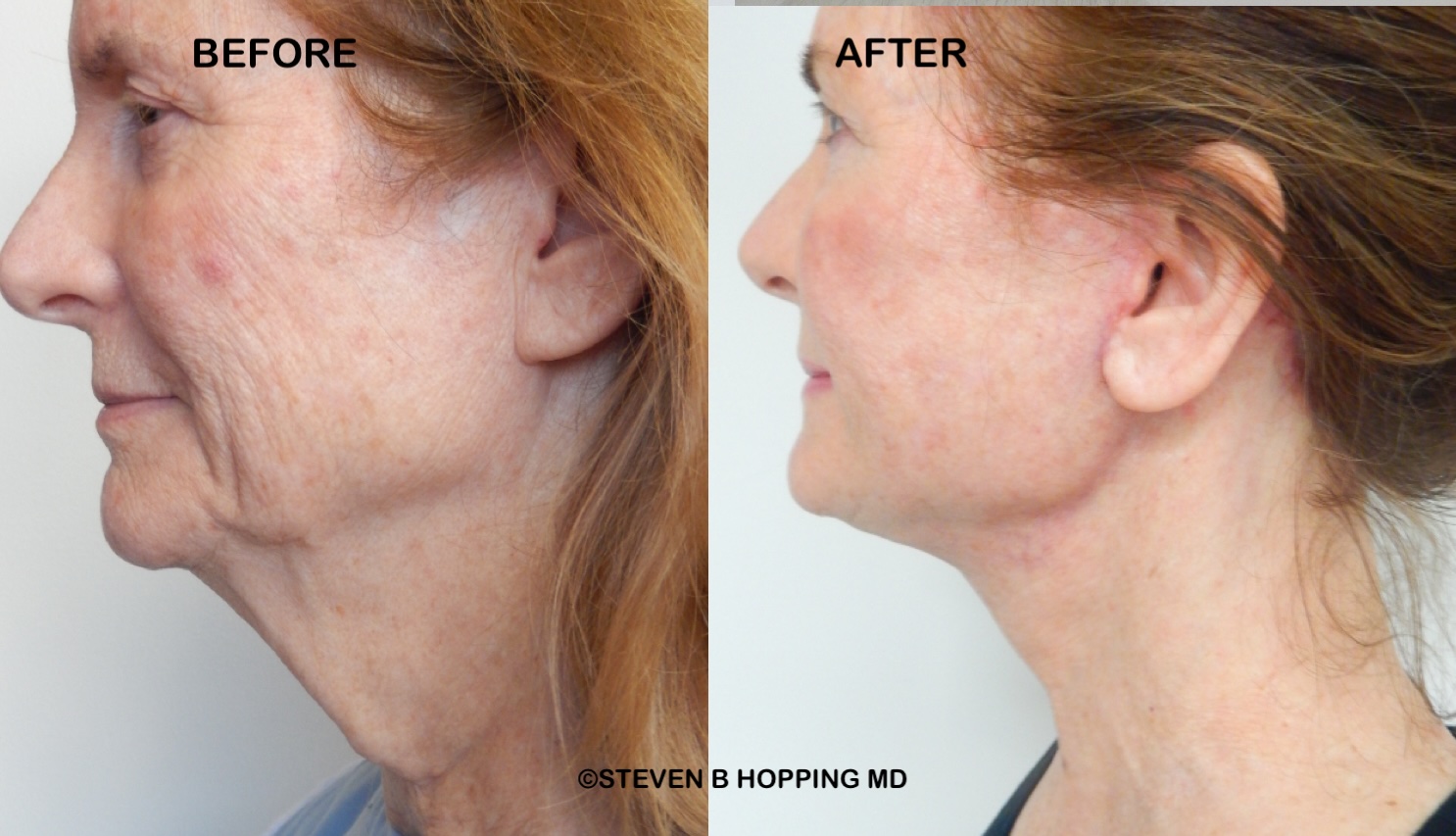
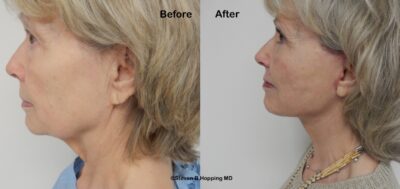
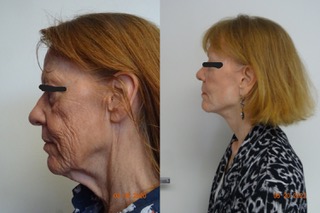
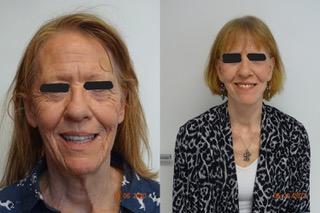
View more before-and-after photos during your office consultation.
What Is a Deep Plane Facelift?
A deep plane facelift is an advanced surgical technique that lifts and repositions the deeper layers of the face, not just the skin on the surface.
Here is why that distinction matters. Beneath your skin is a layer of muscle and connective tissue called the SMAS, short for superficial musculoaponeurotic system. This layer, along with the ligaments that anchor it to your facial bones, is what keeps your face looking full and lifted when you’re younger. As we age, the SMAS and its supporting ligaments loosen, which is a major cause of sagging in the jowls, cheeks, and neck.
A traditional facelift addresses this by tightening the skin. A deep plane facelift goes further. Dr. Hopping releases and repositions the SMAS layer, then lets the skin settle naturally over the corrected structure. Because the underlying support is restored rather than just covered up, results tend to look more natural and last significantly longer.


Deep Plane vs. Traditional Facelift: What's the Difference?
Feature | Traditional Facelift | Deep Plane Facelift |
|---|---|---|
Tissue layer treated: Typical appearance: How long results last: Best suited for: Surgical complexity: | Skin only Can look tight or pulled About 5 to 7 years Mild to moderate signs of aging Moderate | Skin, SMAS layer, and deep facial ligaments Natural, refreshed appearance 10 years or mre Moderate to significant sagging Advanced; requires specialized training |
Am I a Good Candidate?
You may be a good candidate for a deep plane facelift if you have one or more of the following concerns:
- Noticeable jowling, or loose skin along the jawline
- Deep nasolabial folds (the creases that run from the nose to the corners of the mouth) that no longer respond well to injectable fillers
- Sagging in both the midface and the neck
- A desire for results that last many years, rather than a shorter-term improvement
Good general health matters too. Ideal candidates are non-smokers, or are willing to stop smoking well before and after surgery, since smoking slows healing and can affect the final result. Most patients who choose this procedure are between the ages of 40 and 70, though candidacy depends more on your individual anatomy than on age alone.
A consultation is the only reliable way to know whether a deep plane facelift, or a different procedure, is the right fit for your face. Dr. Hopping will examine your skin, muscle tone, and bone structure in person before making a recommendation.
Dr. Hopping's Experience and Approach
Steven B. Hopping, MD, FACS, is a board-certified plastic and reconstructive surgeon who has practiced in the Washington, DC area for decades. He is fellowship-trained in facial plastic and reconstructive surgery and has been named one of America’s Top Doctors by Castle Connolly.
Dr. Hopping personally performs every deep plane facelift he undertakes, from the first incision to the final suture. This procedure requires an intimate knowledge of facial nerve anatomy, since the deeper tissue layers involved sit close to nerve branches that control facial movement. Working at this depth safely takes years of specialized training and hands-on experience.
His approach is guided by these consistent principles:
- Precision at the deep tissue level, releasing and repositioning the SMAS and its supporting ligaments rather than simply tightening the skin
- Individualized planning, since facial aging patterns differ from patient to patient
- A focus on natural outcomes, so the goal is always a rested, refreshed appearance rather than a visibly “done” look
- Combination procedures when appropriate, such as pairing a facelift with a neck lift, eyelid surgery, or fat transfer for more complete rejuvenation in a single recovery period
How the Procedure Works
Step 1: Consultation and planning
Dr. Hopping evaluates your facial anatomy, discusses your goals, and takes photographs and measurements to guide your surgical plan.
Step 2: Anesthesia
The procedure is performed under general anesthesia or IV sedation in our fully accredited, private surgical suite. Our operating suite is certified by the Accreditation Association for Ambulatory Health Care (AAAHC).
Step 3: Incisions
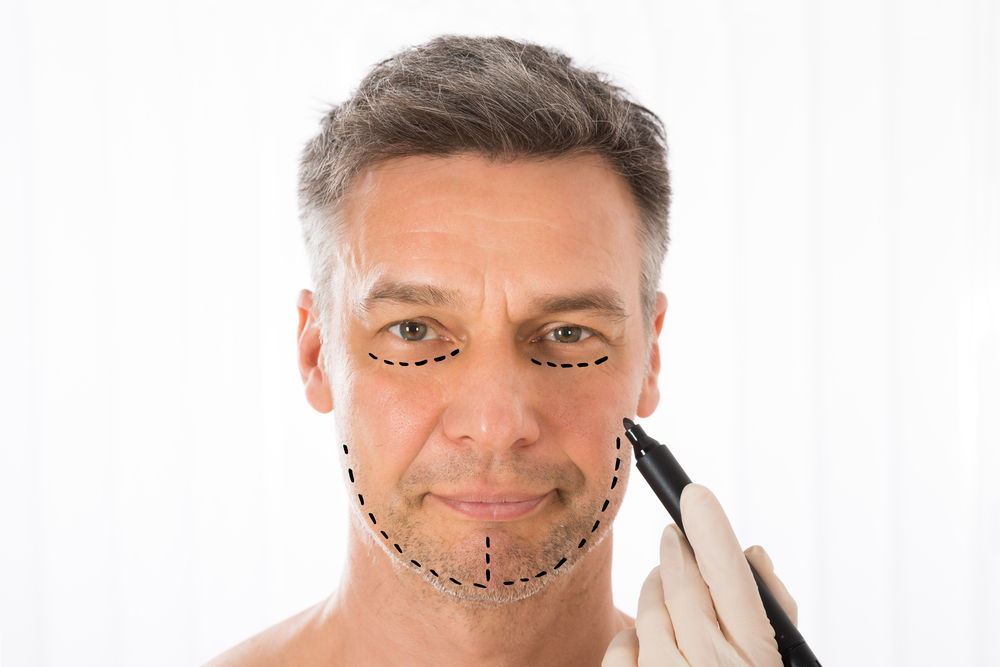
Incisions are placed along the hairline and around the ear, following your natural contours to keep scarring as inconspicuous as possible.
Step 4: Repositioning the deep tissue layer
Working beneath the SMAS layer, Dr. Hopping releases the key facial ligaments and repositions the deeper tissue in a vertical direction, which helps reverse the effects of gravity over time. The skin is then redraped over the corrected structure without excess tension.
Step 5: Closure
Incisions are closed with fine sutures. The full procedure typically takes 4 to 6 hours, depending on whether it is combined with other procedures.
Recovery: What to Expect
Timeframe | What to Expect |
|---|---|
Days 1 to 3 Week 1 to 2 Weeks 2 to 4 Month 1 to 3 6 to 12 months | Swelling, bruising, and tightness are normal. Plan to rest at home. Sutures are removed. Most patients feel comfortable in private settings. Bruising fades significantly. Many patients return to non-strenuous work. Remaining swelling resolves, and results become more visible. The final result is fully visible as deeper tissues settle into place. |
A few steps can support a smoother recovery: sleeping with your head elevated for the first two weeks, keeping healing incisions out of direct sunlight, and following your post-operative instructions closely. Avoiding smoking before and after surgery is especially important, since it can significantly slow healing.
Results: How Long Will It Last?
Most patients see results that last 10 to 15 years, which is notably longer than the 5 to 7 years of a traditional, skin-only facelift. A deep plane facelift restores the deeper structural support, rather than just tightening the skin. The improvement holds up better over time, and continues to look natural as you age.
Many patients maintain their results over the years with non-surgical treatments such as Botox, dermal fillers, or skin resurfacing.
Risks and Safety Considerations
As with any surgical procedure, a deep plane facelift carries some risk. Understanding these possibilities is part of making an informed decision.
- Temporary numbness, swelling, or bruising, which typically resolve within several weeks
- A small risk of nerve irritation affecting facial movement, which is usually temporary and related to the procedure’s depth
- Risks common to any surgery under anesthesia, including infection, bleeding, or an adverse reaction to anesthesia
- Scarring, though incisions are placed to minimize visibility along natural hairlines and contours
Choosing a surgeon with specific, extensive experience in deep plane techniques is one of the most important ways to reduce these risks. Dr. Hopping will review your individual risk factors in detail during your consultation, based on your health history and anatomy.
Frequently Asked Questions
A standard SMAS facelift folds or trims a portion of the SMAS layer without fully releasing the ligaments beneath it. A deep plane facelift goes further, fully releasing those ligaments and repositioning the tissue in a more natural, three-dimensional direction. This typically produces longer-lasting results, especially around the midface and nasolabial folds.
Most patients describe the discomfort as manageable and well-controlled with prescribed medication. Because this technique places less tension on the skin, many patients report less discomfort during healing compared to a traditional facelift.
A comprehensive quote should include the surgeon’s fees, facility costs, anesthesia, and scheduled follow-up visits. Cost also depends on the extent of surgery and whether it’s combined with other procedures. Dr. Hopping provides transparent pricing during your consultation. Financing is available through CareCredit and Alphaeon Credit.
The deep plane technique is specifically designed to avoid the tight, pulled appearance associated with older facelift methods. By moving tissue along the same natural features of your face, results tend to look refreshed rather than altered.
Yes. It’s commonly paired with a neck lift, upper or lower eyelid surgery, fat transfer, or a brow lift, allowing for more comprehensive rejuvenation with a single recovery period.
Candidacy depends on your anatomy and goals more than your age. Most patients are between 45 and 70, but Dr. Hopping evaluates each person individually. Both younger patients with significant sagging and older patients in excellent health can be strong candidates.
Why Choose Dr. Hopping for Your Deep Plane Facelift in Washington, DC?
- Board-certified by the American Board of Plastic Surgery
- Fellowship-trained in facial plastic and reconstructive surgery
- Recognized by Castle Connolly and Washingtonian Magazine as a Top Doctor
- Decades of experience performing advanced facelift techniques in the DC area
- Procedures performed in a private, accredited surgical suite, never a shared hospital operating room
- Every surgery is performed personally by Dr. Hopping, start to finish
Schedule a Consultation in Washington, DC
The best way to find out whether a deep plane facelift is right for you is an in-person consultation. Dr. Hopping will evaluate your facial anatomy, listen to your goals, and give you an honest, detailed assessment of what surgery can realistically achieve, including the results, recovery, and risks specific to your case.
Request a consultation online or give our office a call at (202) 785-3175 to speak with a member of our staff right away.