
The Center for Cosmetic Surgery
Facelift
Medically Reviewed by Steven B. Hopping, MD, FACS at The Center for Cosmetic Surgery October 2026
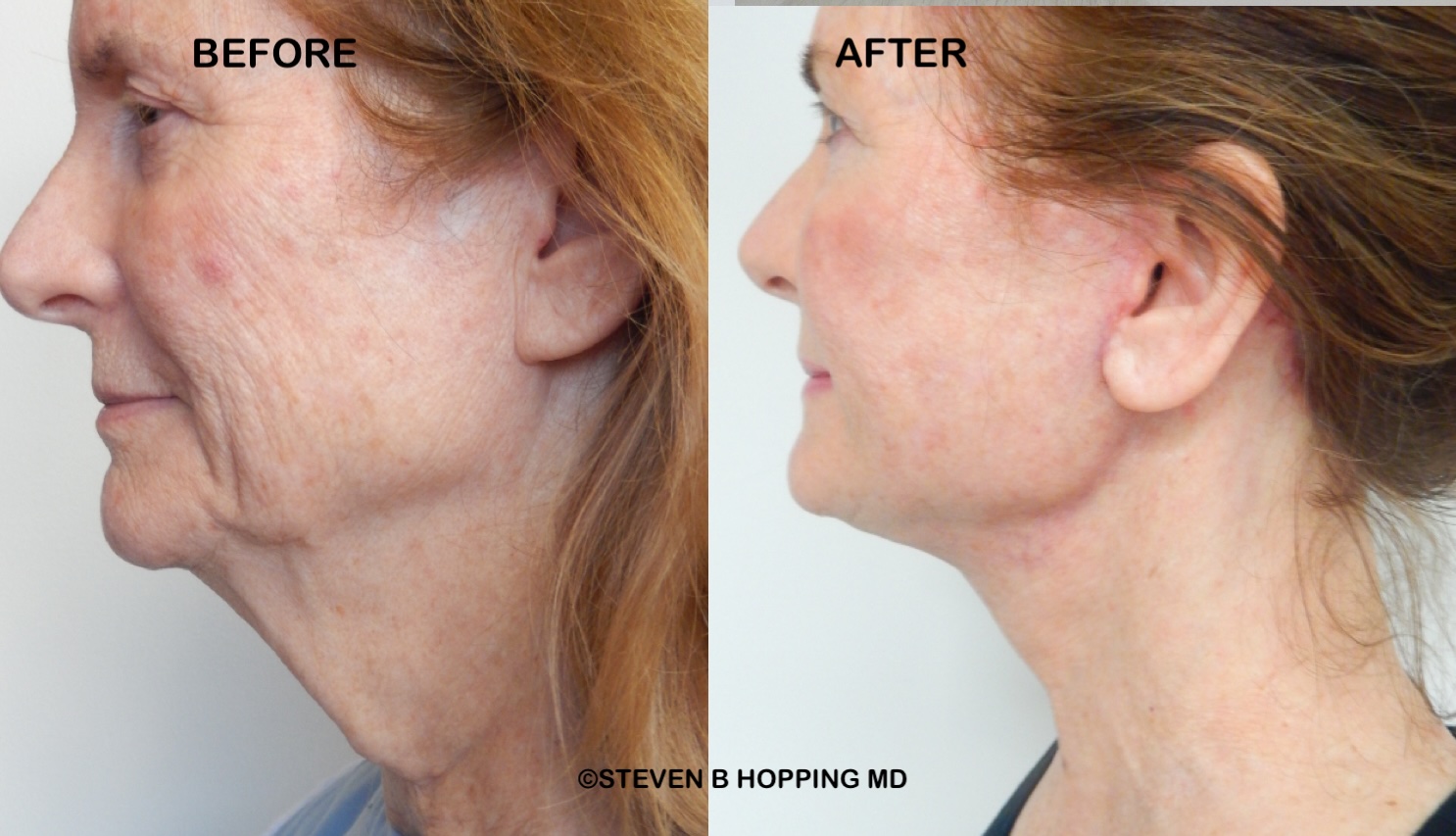
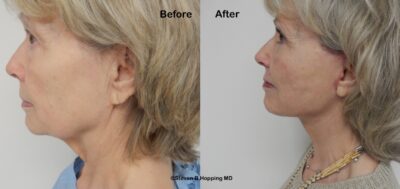
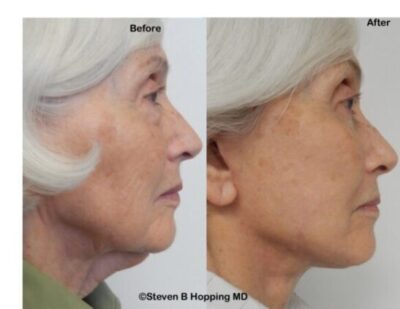
View more before-and-after photos during your office consultation.
Facelift
A facelift in Washington, DC is surgery that lifts a dropped midface, jowls, and neck. The medical name is rhytidectomy. Dr. Steven B. Hopping performs the operation himself at The Center for Cosmetic Surgery. He uses a hidden-scar method he published and lifts the SMAS — the deeper layer that actually holds the face — not the skin alone.
Most patients go home the same day from the practice’s AAAHC-certified facility. A facelift resets how the face hangs. It does not stop aging, and it is not a mini lift with a longer scar. Fallen cheeks need a full lift. A soft early jowl with a stable cheek may only need a mini lift.

What is a Facelift?
A facelift is an operation that reduces visible aging in the face and neck. It treats sagging skin, deep folds, lost midface volume, jowls, and a jawline that has blurred. It is not a laser. It is not filler. It is not a thread.
The SMAS is the muscle and connective-tissue layer under the skin that actually holds the face. Dr. Hopping works on that layer. Skin is laid back without tension after the SMAS is repositioned. That is why results tend to look like you, only less tired, instead of pulled. A skin-only lift can look tight on day one and thin out later. A SMAS lift is built to last longer than that.
Incisions follow hidden-scar principles he published. They sit in the natural hairline and ear contours. You should not see a line across the cheek. When the anatomy calls for it, Dr. Hopping also performs a modified deep-plane lift — a deeper release of the supporting layer than a skin or basic SMAS tuck. It is one tool in the same operation family, used when a deeper release will read more naturally. It is not a second product line, and it is not stamped on every face. If the face is hollow as well as sagging, see Facelift With Fat Transfer.


Who Will Perform Your Facelift Surgery in Washington, DC?
Steven B. Hopping, MD, FACS performs facelift surgery himself at The Center for Cosmetic Surgery, 2311 M Street NW, Suite 503, Washington, DC 20037. It is not handed off to a nurse injector or a visiting operator. Patients come from the District, Maryland, Virginia, and the rest of the DMV.
The boards matter on this operation. He is board-certified in facial plastic and reconstructive surgery, cosmetic surgery, and otolaryngology–head and neck surgery (ENT). ENT is the anatomy of the face, ear, and neck — the same map a facelift uses. He is a Fellow of the American College of Surgeons (FACS) and a clinical professor of surgery at George Washington University.
Cases run as outpatient surgery in the practice’s AAAHC-certified facility. Exam, operation, and follow-up stay in Washington, DC with the same physician.
Facelift vs. Mini Facelift vs. Neck Lift
A full facelift treats a face that has dropped in more than one place — cheeks, folds, jowls, and neck. A mini facelift treats early jowls and a jawline that is just starting to go. A neck lift treats bands and fullness below the jaw when the midface is not the problem.
A mini lift is not a discounted full facelift. Using a mini lift on fallen cheeks usually looks tight without looking younger. Dr. Hopping chooses the operation from the exam, not from a package name.
Full Facelift | Mini Facelift | Neck Lift | |
|---|---|---|---|
Best for:
| Fallen midface, jowls, and neck | Soft jowls, early jawline blur | Bands, turkey neck, jaw–neck angle |
Field: | Midface through neck | Lower Face | Neck and under-chin |
Anesthesia: | Typically general | Often local with IV sedation | Varies with the plan |
Change: | More complete | Modest to moderate | Neck definition |
Read Mini Facelift in Washington, DC and Neck Lift Surgery if only one zone is the complaint.
Am I a Good Candidate for a Facelift?
You may be a good candidate for a facelift in Washington, DC if the midface has dropped, the fold beside the nose is deep, jowls blunt the jaw, or the neck bands show at rest — and skin quality can hold a lift.
You should be in good general health, at a stable weight, and able to stop nicotine before and after surgery. Smoking slows healing and can cost you skin. Age is a weaker test than how far the tissue has descended.
You are probably not a candidate for a full facelift — or not yet — if:
- The only change is a soft early jowl (that is a mini-lift question)
- The neck is the entire problem and the cheeks still hold (that is a neck-lift question)
- You want volume only and the face has not dropped (that is filler or fat, not a lift)
- You cannot stop nicotine or follow aftercare
- You expect a frozen face or a guarantee on how many years it “lasts”
Dr. Hopping decides after he examines tone, bone structure, and the neck. A photo form is not an exam.
How is a Facelift Performed?
A facelift here is outpatient surgery. Most patients go home the same day. Dr. Hopping operates in the AAAHC-certified surgery center.
After anesthesia, he places hidden-scar incisions in the hairline and ear contours, lifts and repositions the SMAS, lays the skin back without pulling it tight, and trims only what is extra. Fat can be added or refined if the face is hollow as well as sagging. Nothing is done as a skin-only tuck.
A light dressing goes on before you leave. Aftercare is written. Follow-up stays in Washington, DC with the same physician.
What Are the Different Facelift Scars?
Facelift scars are planned to hide in the natural hairline and the contours of the ear. That is the published hidden-scar approach used here. You should not see a line across the cheek.
The SMAS is lifted first. Skin is laid back without tension. Low tension keeps a scar fine. Using skin as the handle is what makes a scar wide and a face look pulled.
No incision is invisible on day one. Redness fades over months. Final quality still depends on skin type, sun, nicotine, and aftercare. Scar revision is discussed when needed. It is not promised away in a brochure.
Am I a Good Candidate?
Ideal facelift candidates are in good overall health, free from medical conditions that might affect the healing process.
Additionally, you should be a non-smoker or willing to quit smoking before and after surgery to ensure proper healing. You also need to have realistic expectations about the outcomes and limitations of the procedure.
What is Facelift Recovery Like?
The first three days are the peak of swelling and bruising. Tightness is expected. Rest with the head up. Most people return to light daily activity around days 7 to 10, when stitches or staples, if used, often come out.
The face keeps changing for months. Judge the result at three months, not at day five.
Timeframe | What to Expect |
|---|---|
Days 1 to 3 | Swelling and bruising peak. Rest. Follow the written sheet — not a friend’s aftercare from a different surgeon. |
Days 7 to 10 | Many patients resume light daily activities. Stitches or staples, if used, are often removed. |
Weeks 2 to 3 | Puffiness fades. No heavy gym work, straining, or bending for a prize until you are cleared. |
Weeks 3 to 6 | You look more like yourself in photos. Scars are still pink. Keep them out of the sun. |
Months 3 to 12 | The result refines. Scars soften. This is when “how do I look?” becomes a fair question. |
A facelift is not a weekend procedure. Build calendar space around it.
What Are the Risks of a Facelift?
Risks include bleeding, infection, poor or wide scars, temporary numbness or weakness, asymmetry, fluid under the skin, and the need for a touch-up. Nerve weakness, when it happens, is usually temporary. Nicotine raises the chance of skin-healing problems.
A facelift does not stop aging. It resets the clock. Sun, weight change, and nicotine decide how long that reset reads well. Individual results vary.
The planning risk is the wrong-size operation. A full lift on a face that only needed a mini lift is more surgery than the problem required. A mini lift on a face that needed a full lift looks tight and still aged. That is why the exam comes first.
How Much Does a Facelift Cost in Washington, DC?
You get a written quote after the exam. Not before. Price moves with anesthesia, facility time, whether a neck lift or fat transfer is added, and what aftercare is included.
Online “average facelift cost” charts are not this practice’s fee. A number without an exam is advertising.
Insurance does not cover a facelift done for aging. Call your carrier only if the visit is for a medical condition they already recognize.
Frequently Asked Questions
No. Dr. Hopping works on the SMAS — the deeper muscle and connective tissue — not just the skin.
The SMAS is the muscle and connective-tissue layer under the skin that holds the face. Lifting that layer is what makes a facelift last longer than a skin-only tuck.
A modified deep-plane lift is performed here when the face needs a deeper release of the supporting layer. Many cases are still planned as a hidden-scar SMAS lift. Deep plane is not a sticker put on every chart. Dr. Hopping chooses the layer after the exam and tells you which plan you are actually getting.
In the hairline and ear contours. Not across the cheek. That is the published hidden-scar approach.
Not if the SMAS is lifted first and skin is laid back without tension. Pulled is what happens when skin is used as the handle.
Fallen midface or neck bands at rest point to a full lift or a neck lift. A soft early jowl with a stable cheek points to a mini lift. The exam decides.
Longer than a mini lift. Many full cases take several hours. Adding eyelids, a neck lift, or fat transfer adds time. You get a schedule after the exam.
Plan on 10 to 14 days for desk work if you can hide bruising. Public-facing jobs need more. Do not put a camera week on day eight.
Walking is fine early. Heavy lifting and anything that spikes blood pressure wait until you are cleared — often several weeks, not several days.
Often after the first week or once incisions are closed and you are told it is safe. Keep product out of the suture line until that visit.
Most patients describe tightness and soreness more than sharp pain. The first three days are the peak. Medicine is used as directed.
You will see a better jawline when the dressing is off, then lose some of that to swelling. Judge the result at three months. Scars keep changing for a year.
A facelift resets aging. It does not freeze the face. Sun, weight, and nicotine shorten how long it reads well. There is no honest “lasts 10 years” stamp for every patient.
Yes, when the face is hollow as well as sagging. Fat on top of untreated sag can look heavy. See Facelift With Fat Transfer.
Yes, when those areas need work and one outpatient session is safe. Combining is common because the face ages as a unit.
Yes. Incision planning changes with beard pattern and hairline. The same SMAS and hidden-scar rules apply.
There is no correct age. Some people need it in their 40s. Some wait longer. Descent and skin quality decide — not a birthday.
No. Filler adds volume. Threads are temporary. Neither repositions the SMAS the way surgery does.
Possibly. The face keeps aging. A later lift is not automatically a failed first operation if the first plan was the right size.
Sometimes. If a drain is used, it is usually short-term and removed in follow-up. You will be told before you go home.
Incisions sit in the hairline and ear contours. Hair is managed so the line can be placed cleanly. This is not a hair-transplant shave.
Most facelifts here are outpatient. You go home the same day with a responsible adult. An overnight plan is the exception, not the default, and is decided before surgery.
On your back with the head up. Side-sleeping and stomach-sleeping put pressure on the lift and the incisions. Use the position you were given until you are cleared.
Not until follow-up says the early risk window has passed. Out-of-town patients should plan enough days in DC after surgery so a problem is not handled in another city.
Some numbness around the ears and cheeks is common. It usually fades over weeks to months. Lasting weakness or numbness is uncommon and is reviewed in follow-up.
Yes. Early swelling is often uneven. Sleeping position and small differences in how each side heals do that. It usually evens out as the swelling comes down. Call the office if one side is rapidly larger, hot, or painful.
The hidden-scar plan is built to keep the hairline and earlobe looking like yours. Poor tension is what creates a pulled earlobe or a stepped hairline. That is why skin is not used as the handle.
Often yes. A revision or secondary lift is a different operation: scar tissue, blood supply, and what was done the first time all matter. Bring prior records if you have them.
Stop before surgery and stay off through early healing. Nicotine — cigarettes, vapes, gum, patches — raises the risk of skin loss and wide scars. A date range is given in your pre-op instructions. Do not freelance it.
Sometimes, when the skin surface and the lift can share a recovery without stacking risk. Deep peels and aggressive laser on freshly lifted skin are not automatic add-ons.
After you are shown how and told the incisions can get wet. That is often within the first week, not the first night. Do not scrub the suture line.
See a surgeon who performs the facelift himself, operates in an accredited facility, and will tell you when a mini lift is enough — or not enough. That is the standard at The Center for Cosmetic Surgery.
Schedule a Consultation in Washington, DC
Request an exam if the midface, jowls, or neck have changed and you want a straight answer on full lift vs. mini lift vs. neck lift. Dr. Hopping will look at skin quality, structure, and the neck and match the operation to the face you have.
The Center for Cosmetic Surgery
Steven B. Hopping, MD, FACS
2311 M Street NW, Suite 503, Washington, DC 20037
Phone: (202) 785-3175