
The Center for Cosmetic Surgery
Revision Facelift
Medically Reviewed by Steven B. Hopping, MD, FACS at The Center for Cosmetic Surgery October 2026
View more before-and-after photos during your office consultation.
Revision Facelift
A revision facelift in Washington, DC is surgery that corrects or improves a prior facelift. It is performed by Dr. Steven B. Hopping at The Center for Cosmetic Surgery, 2311 M Street NW. It treats a pulled appearance, visible scars, a distorted ear or hairline, an untreated neck, or new aging after an earlier lift. It improves a prior result. It does not erase it.
A revision facelift is not a repeat of the first operation. Scar tissue, thinner skin, and altered anatomy require a different plan. Most patients return home the same day from the practice’s AAAHC-certified facility.
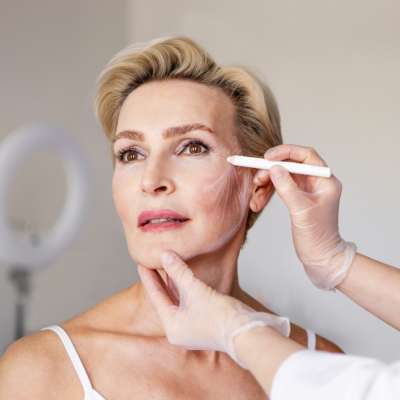
What is a Revision Facelift?
A revision facelift, also called a secondary facelift or secondary rhytidectomy, is surgery on a face that has already had a facelift. Revision facelift surgery in Washington, DC treats two different problems. One is a result that was never right: a pulled look, wide scars, a pixie ear, a raised hairline, asymmetry, or a neck that was ignored. The other is ordinary aging years after a sound first lift.
Those are not the same case. A repair of a distorted ear or a visible scar is a correction. A lift ten or fifteen years later, after a good first result, is a secondary lift for new descent. Dr. Hopping names which one you are having after the exam. Calling every second operation a “failed facelift” is not accurate.
The work is on the deeper layer when that layer can still be moved. Skin is not used as the handle. In a revision, the skin is often thinner and the SMAS may already have been operated on. When anatomy allows, a modified deep-plane release may be part of that plan. It is not stamped on every second operation. The plan follows the anatomy that is left, not a catalog technique.
If the neck was missed, read Neck Lift Surgery. If the face is hollow as well as tight, read Facelift With Fat Transfer. A mini lift is not the fix for a full lift that was the wrong size.
Who Will Perform Your Facelift Surgery in Washington, DC?
Steven B. Hopping, MD, FACS performs revision facelift surgery himself at The Center for Cosmetic Surgery, 2311 M Street NW, Suite 503, Washington, DC 20037. Patients come from the District, Maryland, Virginia, and the rest of the DMV.
He is board-certified in facial plastic and reconstructive surgery, cosmetic surgery, and otolaryngology–head and neck surgery. He is a Fellow of the American College of Surgeons and a clinical professor of surgery at George Washington University. Exam, operation, and follow-up stay with the surgeon who operates, in the practice’s AAAHC-certified facility.
Revision Facelift vs. First Facelift vs. Secondary Lift
A first facelift treats a face that has not been operated on. A revision corrects a problem from a prior lift. A secondary facelift treats new aging after a prior lift that was otherwise acceptable. The incision often follows the old scar so a second line is not added across the cheek.
First Facelift | Revision | Secondary Lift | |
|---|---|---|---|
Why
| First descent of cheek, jowl, or neck | Pulled look, bad scar, pixie ear, missed neck | Aging years after a sound first lift |
Tissue | Unoperated planes | Scar, thinner skin, altered SMAS | Prior scars, new laxity |
Timing | When descent is the problem | Usually after healing, unless an early complication | Often many years later |
Promise | A reset, not a freeze | Improvement, not a full undo | Another reset, not a guarantee |
Read Facelift in Washington, DC, if this would be your first operation. A mini lift is not the fix for a full lift that was the wrong size.
Am I a Good Candidate for a Revision Facelift in DC?
You may be a good candidate for a revision facelift in Washington, DC, if a prior facelift left a visible problem, or the face has dropped again, and you can accept another scar and a recovery.
- A pulled or windswept look from skin used as the handle
- A wide scar, a pixie ear, or a hairline that was lifted out of place
- Jowls or neck bands that were never treated
- New descent years after a prior lift, with stable weight and healed tissue
Good general health matters. Bring operative notes and photos from the first surgery if you have them. Dr. Hopping examines the scars, the ear, the hairline, and the neck in person. A photo is not an exam.
You are probably not a candidate yet if:
- The first surgery was only weeks ago and swelling is still the main change. That is healing, not a failed lift.
- You want the first operation erased. Scar and changed anatomy limit what a second operation can undo.
- You cannot follow aftercare.
- The complaint is volume only and the face has not dropped. That may be fat or filler, not another lift.
How is a Revision Facelift Performed?
Revision facelift surgery is usually outpatient at the AAAHC-certified suite at 2311 M Street NW. After anesthesia, Dr. Hopping opens along the existing incision when that line can be reused, releases scar that is tethering the face, and repositions the deeper layer if it can still be moved safely. Skin is laid back without tension. Only extra skin is trimmed.
A pixie ear is set back toward a more natural position when the lobe was pulled down. A distorted hairline is respected. A missed neck can be treated in the same operation if that is safe. Fat can be added if the face is hollow as well as tight. Nothing is done as another skin-only pull. Most patients go home the same day with written aftercare. Follow-up stays in Washington, DC.
A light dressing goes on before you leave. Aftercare is written. Follow-up stays in Washington, DC with the same physician.
What Are the Revision Facelift Scars Located?
The new incision usually follows the old scar in the hairline and around the ear, so a second line is not placed across the cheek. A wide or misplaced scar can sometimes be removed and closed under less tension. It cannot be promised away.
Low tension is the point. Using skin as the handle is what made many revision scars wide. No incision is invisible on day one. Final quality depends on skin type, sun, and how much skin is left to close.
What is Revision Facelift Recovery Like?
Recovery after a revision facelift in Washington, DC is similar to a first lift, and sometimes slower because of scar. Swelling and bruising peak in the first few days. Rest with the head up. Many patients return to light activity around 10 to 14 days. Judge the correction at three months, not in the first week.
Timeframe | What to Expect |
|---|---|
Days 1 to 3 | Swelling and bruising peak. Tightness is expected. Follow the written sheet from this office. |
Days 7 to 14 | Many patients resume light activity. Stitches, if used, are often removed. Bruising may still show. |
Weeks 2 to 6 | Puffiness fades. No heavy lifting or bending until you are cleared. Keep scars out of the sun. |
Weeks 3 to 12 | The correction can be judged more honestly. Scars keep softening. This is not a weekend procedure.
|
What Are the Risks of a This Type of Facelift Surgery in DC?
A revision facelift carries the risks of a first facelift, and some are higher because the tissue has already been operated on. A scar is expected. Dr. Hopping reviews the risks that apply to you during consultation.
- Bleeding, infection, fluid under the skin, and delayed healing.
- Wider scars, a remaining pixie ear, or a hairline that cannot be fully restored.
- Temporary numbness or weakness. Nerve injury is uncommon and is usually temporary, but prior surgery can make the planes less clear.
- Skin loss, especially if the skin is closed under tension.
- Asymmetry, and the need for a later touch-up. A revision is an improvement, not a guarantee of a first-surgery face.
Individual results vary. This page is not a complete risk list. Operative records from the first surgery help. They do not remove the risk.
How Much Does a Revision Facelift Cost in Washington, DC?
Revision facelift cost in Washington, DC is a written quote after the exam. It often costs more than a first lift because the operation takes longer and the anatomy is less predictable. Price moves with scar work, neck treatment, fat transfer, anesthesia, and facility time. Online averages are not this practice’s fee. Insurance does not cover a revision done for appearance.
Frequently Asked Questions
A revision corrects a problem from the first operation, such as a pulled look, a bad scar, or a pixie ear. A secondary facelift treats new aging after a prior lift that was otherwise acceptable. The exam decides which word fits.
Not while swelling is still the main change. Most corrections wait until the first operation has healed, often 6 to 12 months. An early problem such as bleeding or skin loss is a different timetable and is handled as a complication, not as an elective revision.
Often it can be improved, if skin was used as the handle and deeper tissue can still be released. It cannot always restore the face to the way it looked before the first surgery.
A pixie ear is a lobe pulled down by tension. It can often be set back when there is enough tissue. A perfect pre-surgery ear is not a promise.
A wide scar can often be excised and closed under less tension, usually in the same hairline and ear line. The scar fades. It does not disappear.
A skin-only lift often thins out sooner because the deeper layer was never moved. Weight change and sun also shorten a result. A later lift is not automatically a failed first operation if the first plan was the right size.
Bring it if you have it. It tells which layer was lifted and where the scars were placed. The exam still decides. A missing report does not block a consultation.
Yes, in some ways. Scar, thinner skin, and less clear planes raise the chance of healing problems and nerve irritation. That is why tension and scar matter more the second time.
The goal is the opposite. Skin is laid back without tension. Tight is what a skin-only pull produces. A revision that pulls the skin again repeats the problem.
Yes, when the face is hollow as well as scarred or sagging. Fat on top of untreated tightness can look heavy. The release comes first. See Facelift With Fat Transfer.
Yes, when bands or fullness under the jaw were missed and one session is safe. A facelift scar alone does not treat a turkey neck. Read Neck Lift Surgery.
Often longer than a first lift, because scar must be released. You get a schedule after the exam, not from a web average.
Plan on 10 to 14 days for desk work if bruising can be hidden. Public-facing work needs more. Do not book a camera week in the first 10 days.
Walking starts early. Heavy lifting and anything that raises blood pressure wait until you are cleared, often several weeks.
Most patients describe tightness and soreness more than sharp pain. The first three days are the peak. Medicine is used as directed.
You may see a change when the dressing is off, then lose some of it to swelling. Judge the correction at three months. Scars keep changing for a year.
A revision resets the problem it was built to treat. It does not stop aging. There is no honest number of years for every face.
Yes. Beard pattern and hairline change the incision plan. The same rules apply: do not use skin as the handle.
That is common. Bring records if you have them. The operation is planned from the face you have now, at 2311 M Street NW.
Most revision facelifts here are outpatient. You go home the same day with a responsible adult. An overnight plan is the exception and is decided before surgery.
On your back with the head up. Side-sleeping and stomach-sleeping put pressure on the lift and the incisions. Use the position you were given until you are cleared.
Not until follow-up says the early risk window has passed. Out-of-town patients should plan enough days in DC after surgery.
Not while you are taking narcotic pain medicine and not while swelling keeps you from turning to check a blind spot. Get the all-clear in the office.
Some numbness around the ears and cheeks is common. It usually fades over weeks to months. Lasting weakness or numbness is uncommon and is reviewed in follow-up.
Yes. Early swelling is often uneven. Sleeping position and prior scar can make one side fuller. It usually evens out as the swelling comes down. Call the office if one side is rapidly larger, hot, or painful.
Yes, early on. Fluid settles overnight. It is not a failed revision. It usually eases through the day as you are up and moving.
After you are shown how and told the incisions can get wet. That is often within the first week, not the first night. Do not scrub the suture line.
Bring every medicine and supplement list to the pre-op visit. Do not stop a prescribed blood thinner because a web page said so. The office will tell you what to pause and what must stay.
See a surgeon who performs the revision himself, operates in an accredited facility, and will say when you are still swollen rather than failed. That is the standard at The Center for Cosmetic Surgery.
Schedule a Consultation in Washington, DC
Request an exam if a prior facelift looks pulled, scarred, or aged again and you want a straight answer on revision versus waiting. Dr. Hopping will look at the scars, the ear, the hairline and the neck.
The Center for Cosmetic Surgery
Steven B. Hopping, MD, FACS
2311 M Street NW, Suite 503, Washington, DC 20037
Phone: (202) 785-3175